Gareth Matthes Ecology is an ecological consultancy that has been running since 2002,
with offices based in Surrey, Dorset and associates across the UK. Over the
last decade clients have included housing associations, private developers,
private land-owners, local authorities, utility companies, government agencies,
and nature conservation groups. GPM Ecology and associates can provide
for the following ecological services:
December 2011 - SEASONS GREETINGS & GOOD LUCK FOR THE NEW YEAR
Over the last three years Gareth has helped-out as an assistant leader at 1st Haslemere Scouts, run by the extremely dedicated Short-family, providing a great support to the youth of Haslemere. GPM Ecology has given a small donation to Haslemere Scouts towards their activities for 2012. In addition we are making our regular donations to Handicap International UK, an independent aid organisation working in situations of poverty and exclusion, conflict and disaster. Presently they are active in lobbying government, asking Vince Cable to stop UK banks funding cluster bombs. Support HI(UK), check out their website and enter their cluster-bomb questionnaire.
November 2011 - DORMICE LATE TO SLUMBER, IN A VERY MILD AUTUMN
For over six years Gareth has been involved with the National Dormouse Monitoring Programme (NDMP) assisting surveys at a private 1.3ha wood on the outskirts of Haslemere. The population density at this wood is higher than average with the site, having been in the top ten out of 150+ NDMP woods over the last 5-years. This year we had 20 Dormice from 50 boxes during October and a further two still active at the final check on a very mild 22nd November. Earlier in October Dave Williams of Surrey Dormice Group became an overnight hit with his snoring Dormouse video.
October 2011 - AUTUMN POND MANAGEMENT
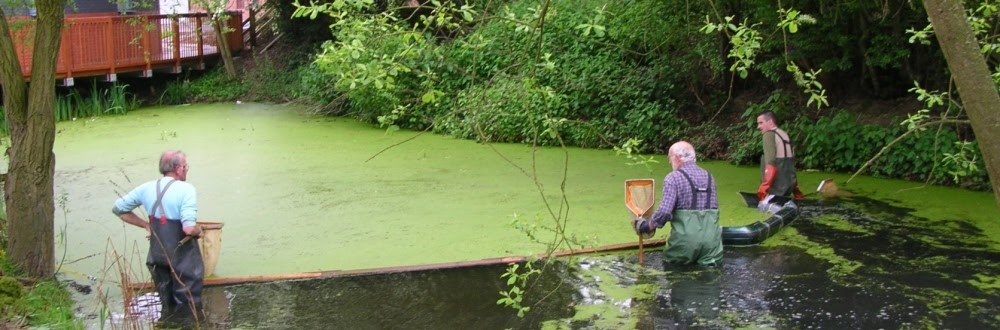
Autumn is the most practical time of year to conduct pond management, with low water-levels meaning easy access and minimal impact upon pond life. During autumn 2011 mitigation at a water-treatment works refurbishment included relocation of newts. On behalf of 4Delivery GPM Ecology removed pond plants on 21st October from a small wildlife pond at Nursling Primary School, accommodating 35 newts (smooth and palmate) relocated from the treatment works. It took 4-man hours to clear about 8m sq., allowing the school to utilise this pond again for pond-dipping. Tools for the job included: two personnel, spade, fork, manure drag and wheel-barrow.
Hayden and Nikki (School Council) of Nursling Primary School, Nursling Street, Southampton, SO16 0XH wrote the following to GPM Ecology and 4Delivery: 'Thank you for cleaning up our pond. We really appreciate it. It looks much better. We’ll try and keep it as clean as it looks as you did a really good job on cleaning it up.'
September 2011 - UPDATED REPTILE MITIGATION GUIDELINES, FOLLOWING A LATE SUMMER SLOW-WORM TRANSLOCATION AND SURVEY BONANZA!
GPM Ecology has never been so busy in September, with four reptile translocations and three surveys conducted during this month. Three of the projects were on Southern Water waste-treatment improvement schemes; two in relation to sheltered-accommodation bungalow refurbishments with a Housing Association; one at a Surrey-heathland style golf course and another on a small private housing scheme in conjunction with Surrey Wildlife Trust consultancy. On 9th September 2011 Natural England published the long-awaited Reptile Mitigation Guidelines, which have not be updated since Froglife guidelines dating back to 1998.
POST-SCRIPT: By end of October 2011 Natural England had removed this publication.
August 2011 - TO BE OR NOT TO BE A HEDGE?
GPM Ecology has been involved in a major housing allocation in the Midlands since 2007, proposals having included 300 dwellings, a relief road and associated Open Space. On-site monitoring has included detailed botanical, hedgerow, invertebrate, bird, bat, reptile and badger surveys. During initial 2007 surveys the proposed development cut through an 'important' hedge, protected under Hedgerow Regulations 1997, with several defunct hedges also impacted. By August 2011 hedgerow features had grown to the extent that the 'important' hedge was now over 5m wide (too wide to be considered a hedge?) and the defunct hedges had grown into favourable priority BAP hedges!
Hedgerow: is any boundary line of trees or shrubs over 20m long and less than 5m wide, provided that at one time the trees or shrubs were more or less continuous, as defined by Bickmore C. 2002, Hedgerow Survey Handbook - standard procedure for local surveys in the UK, DEFRA and CCW.
'Important' Hedge: hedgerows protected under the Hedgerow Regulations 1997 and meeting the legislation where a hedge is species-rich (at least on average 4 woody species per section) and supports associated features (e.g. hedgerow trees, ditches, parallel hedges, connected to woods, hedges or ponds etc.) - refer to DEFRA (1998) The Hedgerow Regulations 1997: a guide to the law and good practise, HMSO.
Defunct-hedge: hedges with more than 10% gaps and sections with over 20m between trees / shrubs, usually intensively managed, through over-grazing, over-cutting or affected by Dutch-elm disease. These hedges can be Priority BAP hedges or could even be covered by the Hedgerow Regulations 1997. This is a term derived from, but not specifically defined by Joint Nature Conservation Committee 1993, Handbook for Phase 1 habitat survey - a technique for environmental audit, JNCC, Peterborough.
Priority BAP hedges: are hedges consisting predominantly (i.e. 80% or more cover) of at least one woody UK native species, as described by UK Biodiversity Action Plan: Priority Habitats Description. (BRIG ed. Ant Maddock) 2008 andwww.hedgelink.org.uk/hedgerow-biodiversity-action-plan.htm
GPM Ecology on Twitter! Click on the link above to begin following.